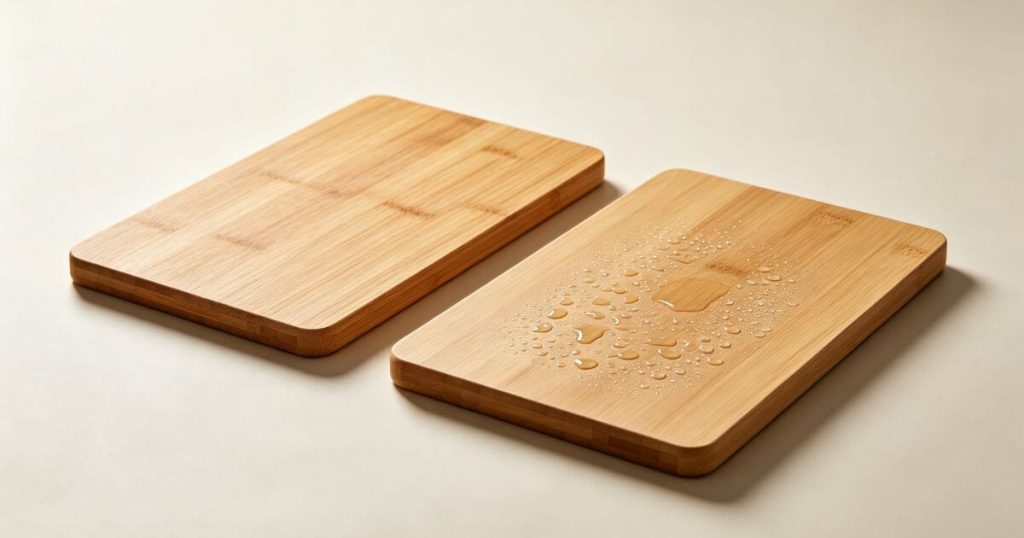
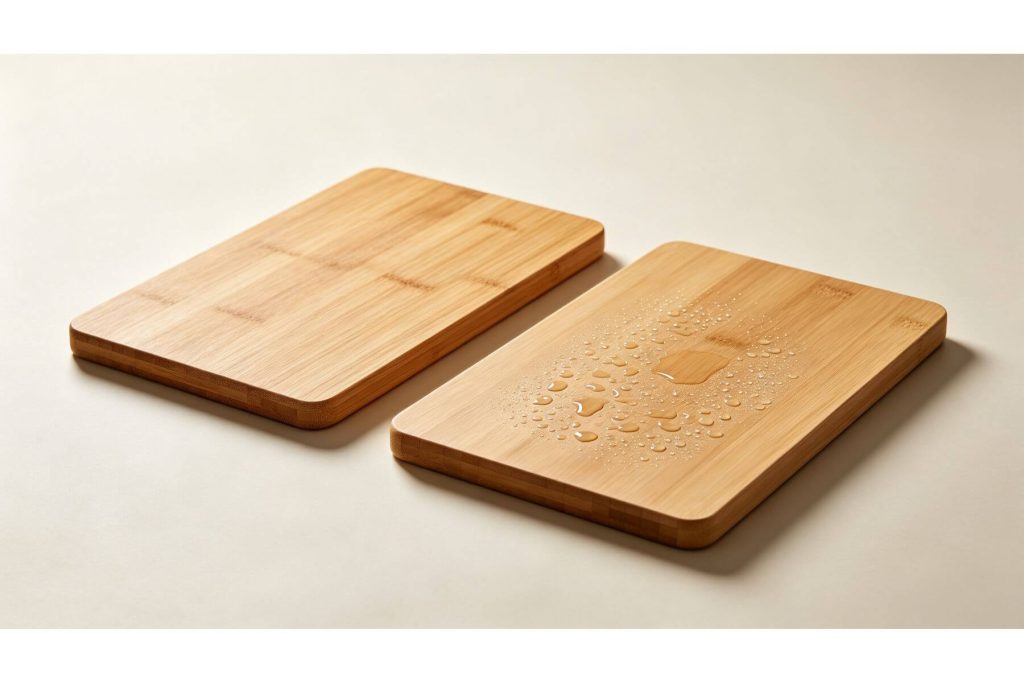
Many common issues – including whitening, discoloration, blotching, peeling, and poor dishwasher performance – are closely related to how the substrate, finish, and curing process interact with water, oil, heat, and detergents.
That is why the surface finish decides how a cutting board performs, how it complies, and which market it fits.
This guide covers the four main finishes, their performance and compliance behavior, and how to match a finish to your target market.
Why Surface Finish Matters
The finish decides five things:
- Appearance – open natural grain vs uniform coating
- Care level – hand-wash only vs household dishwasher safe
- Compliance stability – whether the finish can be formulated and tested to meet applicable FDA / LFGB food-contact requirements
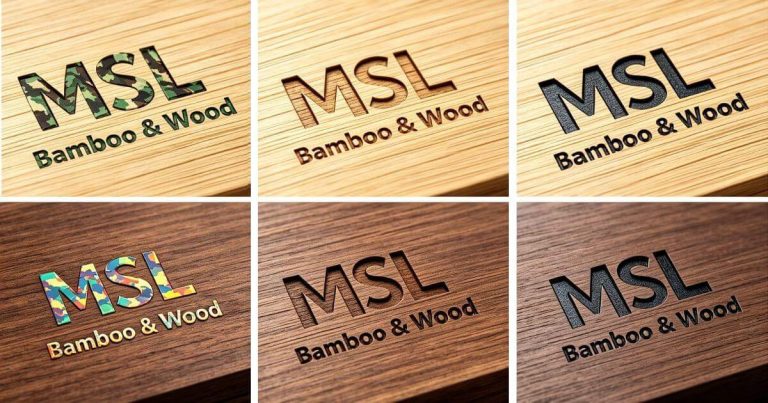
- Logo durability – UV printing vs laser engraving
- Cost and lead time – coating layers, curing time, rework rate
For B2B buyers, the finish is often the difference between a mass retail SKU and a premium gift SKU.
The Four Main Finishes
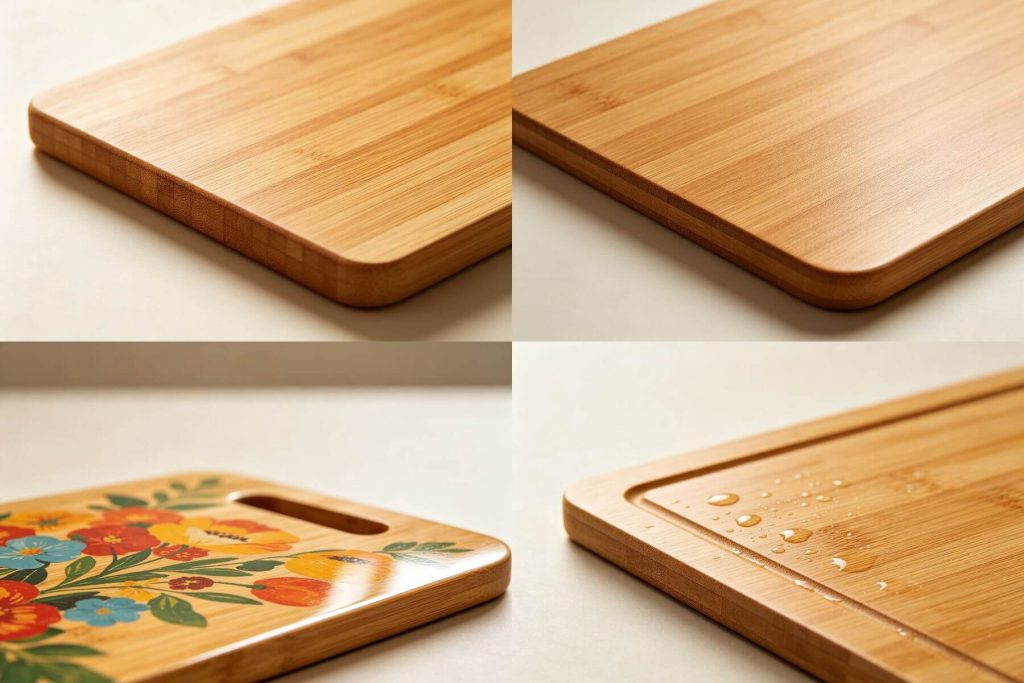
1. Wood Wax Oil (Sealer + Sanding + Food-Grade Wax Oil)
Open-grain, natural look finish. Process: fine sanding, thin sealer coat, curing, fine sanding, dust removal, food-grade wood wax oil application.
- Thin sealer: seals wood pore variation, balances oil absorption, prevents blotches and color unevenness. Not a thick coat, does not cover grain.
- Sanding after sealer: removes surface sealer film, keeps open grain, restores natural touch. This step is mandatory.
- Wood wax oil: penetrates surface fibers, enhances grain color, protective finish.
Best for: natural, eco-friendly, premium home lines.
Dishwasher: No. Hand-wash only.
Compliance: standard wood wax oil carries food-migration risk. Food-grade formulations can be formulated and tested to meet applicable FDA / LFGB food-contact requirements.
Note: wood wax oil is a penetrating pre-treatment, not a sealed film. End users need to re-oil periodically.
2. Nitrocellulose Lacquer
Thin film finish. Forms an even, light lacquer film on the surface, resists water absorption and stains better than open-grain wood wax oil. Uniform color across batches.
Best for: compliant hand-wash lines, supermarket mass retail.
Dishwasher: No. Hand-wash only.
Compliance: food-grade nitrocellulose formulations can be formulated and tested to meet applicable FDA / LFGB food-contact requirements.
3. UV Coating
Mainly used for printed patterns and colored logos. Ink is printed first, then UV top coat is cured over it.
Best for: hand-wash printed SKUs, holiday and licensed designs.
Dishwasher: No. UV-printed and UV-coated surfaces are generally better suited to hand-wash products, as repeated dishwasher heat, moisture, and detergent exposure can affect print and coating durability.
4. Double-Layer Food-Grade Water-Based Lacquer
Process: fine sanding, water-based primer spray to seal pores, primer curing and sanding, water-based top coat spray, controlled temperature curing. Primer sanding and controlled curing are critical for dishwasher durability.
Forms a continuous food-grade sealed film that separates the wood from moisture.
Best for: dishwasher-safe product lines.
Dishwasher: Designed and tested for household dishwasher use.
Compliance: can be formulated and tested to meet applicable FDA / LFGB food-contact requirements.
Note: maintenance-free, no whitening, no fuzzing, no water absorption. Tested under standard household conditions, not commercial high-temperature dishwashers.
Comparison Table
| Finish | Best For | Dishwasher Safe | Compliance Stability | Logo Durability | Key Trait |
|---|---|---|---|---|---|
| Wood wax oil (sealer + sanding + wax oil) | Natural, premium hand-wash lines | No | Standard formula carries risk; food-grade can meet requirements | Engraving highly durable; UV not suitable | Open grain, warm touch, needs periodic re-oiling |
| Nitrocellulose lacquer | Compliant hand-wash lines | No | Can meet FDA / LFGB requirements | Engraving highly durable; UV usable | Even film, uniform color, better stain resistance |
| UV coating | Printed hand-wash SKUs | No | Depends on base finish | UV hand-wash only; engraving highly durable | Glossy surface, vivid print |
| Double-layer water-based lacquer | Dishwasher-safe lines | Designed and tested for household dishwasher use | Can meet FDA / LFGB requirements | Engraving highly durable; UV not suitable | Sealed film, moisture barrier, durable |
Note: all four finishes apply to both bamboo and solid wood substrates.
Logo Process: UV Printing vs Laser Engraving
| Item | UV Printing | Laser Engraving |
|---|---|---|
| How it works | Ink printed, then UV top coat cured | Physically carved into wood fibers |
| Durability | Repeated dishwasher heat, moisture, and detergent can affect print and coating durability | Highly durable |
| Applicable lines | Better suited to hand-wash products | Hand-wash and dishwasher-safe |
| Color patterns | Supported | Not supported, single-color mark only |
| Recommended for | Holiday, licensed, colored logos | Brand logos, long-term marks |
In one line: UV printing is better suited to hand-wash products, while laser engraving provides a more permanent mark.
Selection guide:
- Printed color logo → nitrocellulose base + UV, hand-wash
- Dishwasher-safe → water-based lacquer base + laser engraving
- Natural line → sealer + wood wax oil + laser engraving
UV printing and screen printing are hand-wash only and not recommended for dishwasher-safe SKUs. Laser engraving is the preferred logo method for dishwasher-safe lines. For a full comparison of UV printing, laser engraving, and screen printing, see our logo customization guide.
How to Choose a Finish for Your Market
| Target Market | Recommended Finish | Compliance | Why |
|---|---|---|---|
| Amazon / e-commerce, gift sets | Wood wax oil (food-grade) | Evaluated per order | Natural look sells well on product photos; especially popular for cheese boards and charcuterie |
| Supermarket, mass retail | Nitrocellulose lacquer | Can meet FDA / LFGB | Uniform color, compliant, low maintenance |
| Holiday, licensed, printed SKUs | UV coating | Depends on base finish | Best print reproduction, hand-wash accepted |
| Dishwasher-safe demand | Double-layer water-based lacquer | Can meet FDA / LFGB | Designed and tested for household dishwasher use |
| Premium walnut cheese boards | Wood wax oil | Evaluated per order | Preserves dark grain, thick coatings reduce value |
Common Mistakes Buyers Make
- Mixing a wood wax oil base with UV printing – ink will not adhere properly.
- Listing hand-wash SKUs as dishwasher safe – returns and negative reviews follow.
- Ordering dishwasher-safe walnut – the lacquer hides the grain that makes walnut premium.
- Testing certification on one finish and shipping another – FDA and LFGB apply to the whole base-plus-finish system.
- Assuming standard wood wax oil meets FDA / LFGB – food-grade formulations are required.
- Applying UV printing to dishwasher-safe SKUs – repeated dishwasher heat, moisture, and detergent can affect print durability.
Next Steps
If you are sourcing bamboo or wood cutting boards, tell us your target market, channel, and care expectation. We will recommend the finish that matches your price band and compliance scope. For a full comparison of logo methods, see our logo customization guide.